FORECAST CITY
Sign in
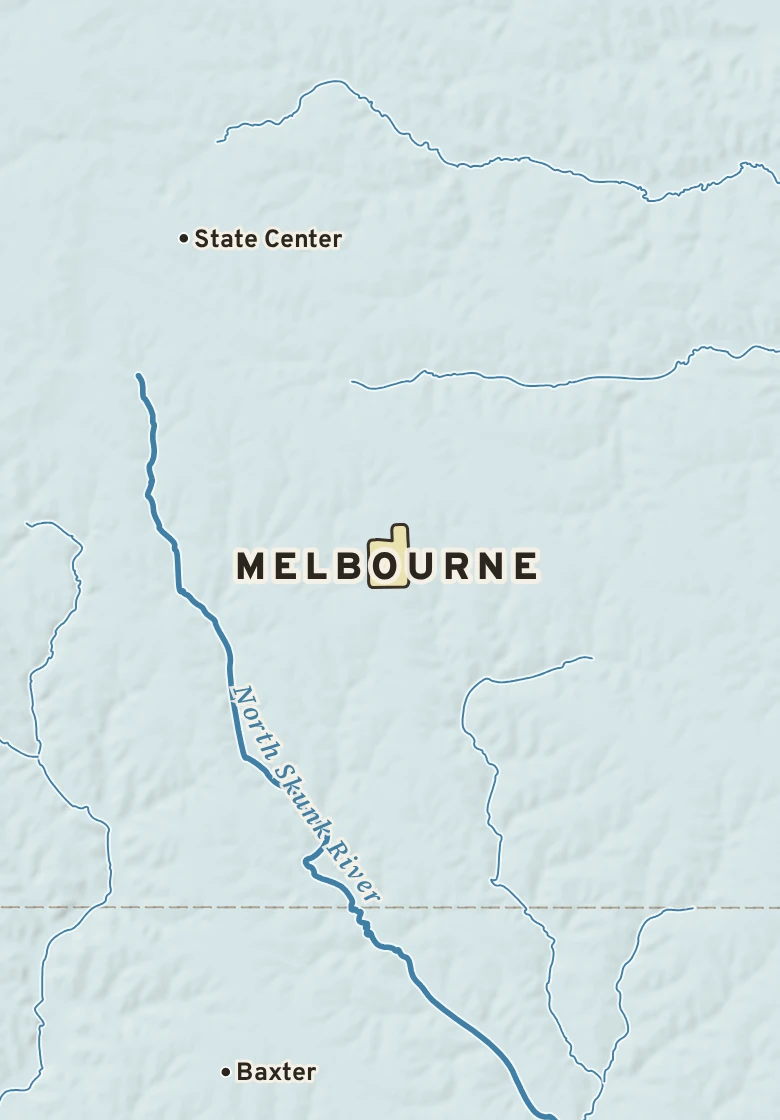
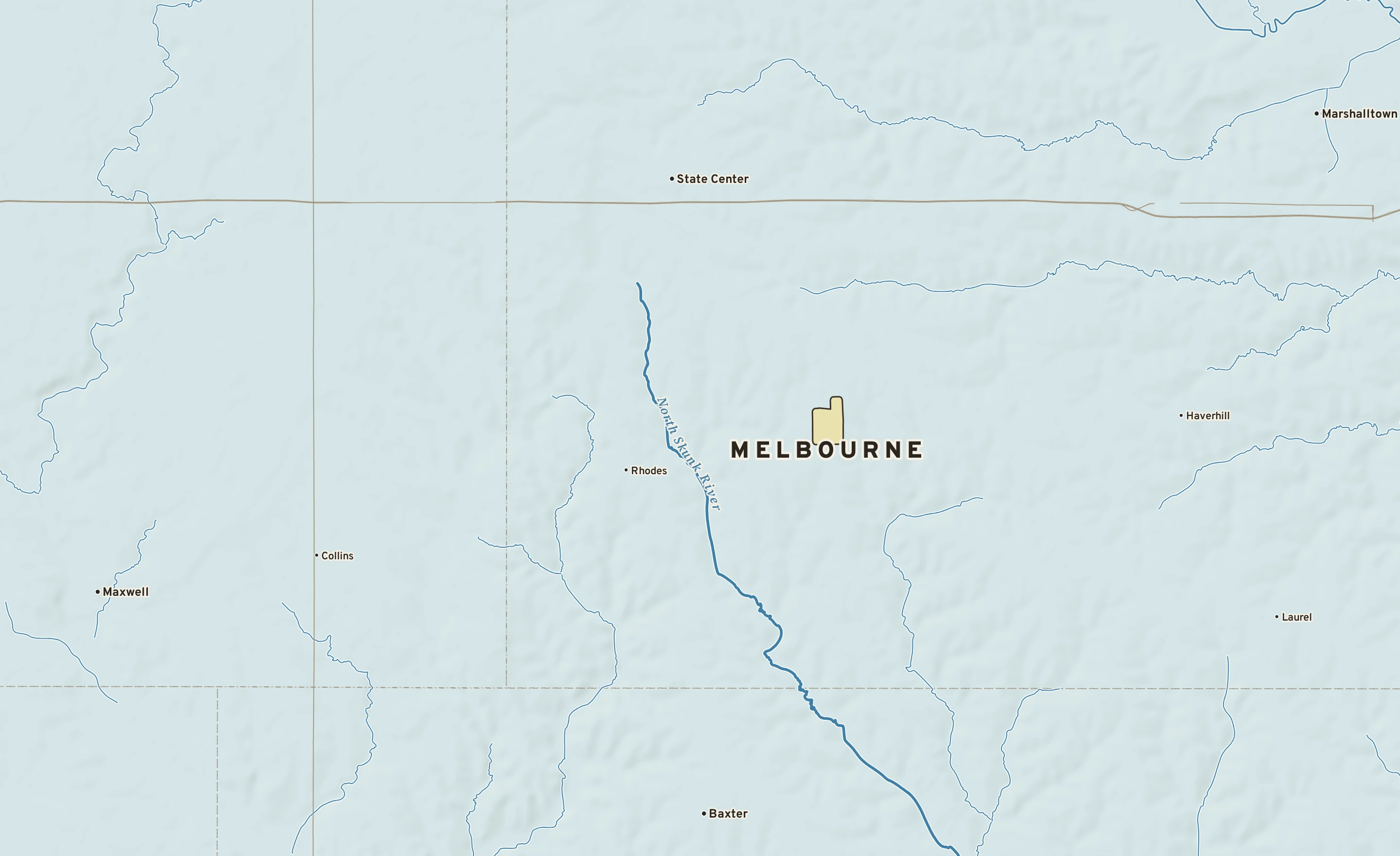
Shaded-relief map of Melbourne, Iowa: rivers, roads, the city limits and where the water drains.
IOWA · MARSHALL COUNTY

Melbourne

771 people, 1,050 ft above sea level in Marshall County.

1,050 ftElevation, city center
771People, 2024 estimate
1 sq miLand area
Sunny 44°
Sunny now Dew point 27° · S 6 mph · high 44°
City of Melbourne River Interstate 2 miles
Explore the plate Order a print

The Melbourne plate. Relief from Copernicus GLO-30; rivers and lakes from USGS NHD; watersheds from the USGS Watershed Boundary Dataset; roads and city limits from Census TIGER 2024.

MILE1
TODAY

Today in Melbourne

NWS forecast and National Blend of Models · updated 12:00 PM CST
RIGHT NOW Pella Municipal Airport (KPEA) · 1:55 PM
Sunny
44° Sunny Feels like 41° · high of 44° near 2 PM
WindS 6 mphno gusts
Humidity50%falling to 49% this afternoon
Pressure30.29 in →steady
Visibility10 mihaze-free
CloudsClear
UV index—no forecast
Dew point 27° · Dry38° by Tuesday: more humid
DryComfortableStickyMuggyOppressive
NEXT RAIN
Showers
Friday60% chance · showers
LIKELY AMOUNT—amounts come within 3 days
LAST RAINNov. 70.02 in · 7 dry days
ALERTS & OUTLOOKS
No watches or warnings for Marshall County
NWS Des Moines and the Storm Prediction Center · checked 2:15 PM
SUN & MOON
↑ 7:00 AM4:52 PM ↓
9 h 51 m of daylight, 2 minutes less than yesterday
Waxing crescent, 25% lit. Next full moon: Nov. 24.
AIR & POLLEN
55
MODERATEAir quality index · fine particles
Tomorrow: None, moderate. No pollen source yet.

The next three days, hour by hour

Sky: clear, cloudy, night Rain likely National Blend of Models
SATURDAY, NOV. 14
SUNDAY, NOV. 15
MONDAY, NOV. 16
TUESDAY, NOV. 17
2p
5p
8p
11p
2a
5a
8a
11a
2p
5p
8p
11p
2a
5a
8a
11a
2p
5p
8p
11p
2a
5a
8a
11a
clear day
clear night
mostly clear night
mostly clear night
partly cloudy night
partly cloudy night
partly cloudy day
mostly sunny
mostly sunny
mostly clear night
mostly clear night
clear night
mostly clear night
mostly clear night
mostly sunny
mostly sunny
clear day
clear night
clear night
mostly clear night
mostly clear night
mostly clear night
mostly sunny
mostly sunny
TEMPERATURE °F
44°
24°
47°
27°
52°
34°
CHANCE OF RAIN
50%
WIND, MPH
0
0
0
0
0
0
0
5
3
2
3
3
3
3
6
8
9
7
7
7
7
7
9
12
HOW IT FEELS · DEW POINT
Dry: dew points 23 to 38° More humid: 38° by Tuesday

The next seven days, and how sure we are

Forecast, with the range 8 in 10 ensemble members agree on Normal, about 47° / 27°
SAT Nov. 14 Sunny Sunny
44° 25°
0% rain — SSW 0 A
SUN Nov. 15 Partly cloudy Partly cloudy
50° 27°
0% rain — S 2 B
MON Nov. 16 Mostly sunny Mostly sunny
54° 34°
0% rain — SSW 7 B
TUE Nov. 17 Mostly sunny Mostly sunny
57° 40°
0% rain — S 9 A
WED Nov. 18 Partly cloudy Partly cloudy
59° 48°
20% rain — S 12 B
THU Nov. 19 Mostly sunny Mostly sunny
60° 44°
20% rain — W 3 C
FRI Nov. 20 Chance of showers Chance of showers
62° 51°
60% rain up to 0.4″ SE 9 C
How sure are we? AModels agree: highs within 4° BSome spread: within 8° CWide spread: check back
Range from the National Blend of Models percentiles · graded on Forecast Scores
AIR MAIL

Where today’s air came from

The air arriving over Melbourne about 5,000 feet above the ground was over the open Pacific three days ago, and over the central Plains a day ago, about 2,570 miles back along its path. It came down from about 17,700 feet up, warming and drying as it sank. Near the ground the air came from British Columbia; at 10,000 feet, from the northern Rockies. It feels dry all the same. Traced back 72 hours through NOAA’s hourly RAP analyses and the GFS beyond them, nine paths at each of three heights.

THIS WEEK IN 1999 Nov. 14, 1999

The hottest this week has been

80° on Nov. 14, 1999, the hottest reading for this week of the year since 1893. Next is 77° in 1941.

77°
80°
19411999
Source: NOAA RCC-ACIS, the Marshalltown record since 1893.
MILE2
THE GROUND

What Melbourne stands on

Melbourne’s center stands about 1,050 ft above sea level. Within three miles the land runs from 940 ft to 1,050 ft, a difference of 110 ft: gently rolling country.

Under the town center the state geologic map shows Lower Cherokee Group and Raccoon Creek Group (shale, sandstone, siltstone), from the Early Pennsylvanian to Middle Pennsylvanian, 307 to 324 million years old.

The section below crosses 4 rock units mapped at the surface.

Melbourne, cut in half from northwest to southeast

A section northwest to southeast, 24 miles through the town center
900 ft1,000 ft1,100 ft MELBOURNE1,050 ftHigh point of the line1,130 ftLow point900 ft ← NWSE →

Heights every 0.1 mile from the Copernicus GLO-90 surface model; vertical exaggeration about 64×. The colored band under the surface is the rock the state geologic map shows at the surface, not a picture of what lies beneath.

Rock at the surface along the line

Lower Cherokee Group and Raccoon Creek Group

Shale, sandstone, siltstone. Age: Early Pennsylvanian to Middle Pennsylvanian, 307 to 324 million years old. About 16 mi of the line.

Augusta Group

Dolostone, limestone. Age: Early Mississippian to Middle Mississippian, 331 to 359 million years old. About 5 mi of the line.

St. Louis and Pella Formations

Dolostone, limestone. Age: Middle Mississippian to Late Mississippian, 324 to 347 million years old. About 3 mi of the line.

Gilmore City Formation

Limestone. Age: Early Mississippian to Middle Mississippian, 331 to 359 million years old. About 0.6 mi of the line.

From the USGS State Geologic Map Compilation (Horton and others, 2017), the states’ geologic maps joined at a common scale.

Heights from Copernicus GLO-90 (a surface model: it includes buildings and tree canopy); summits from USGS GNIS; rivers from USGS NHDPlus HR; rock from the USGS State Geologic Map Compilation.

MILE3
THE WATER

Where Melbourne’s rain goes

A raindrop that lands in Melbourne reaches the Gulf of America by way of the North Skunk, the Skunk and the Mississippi: about 1,580 river miles.

THE WAY DOWN, TO SCALE
Melbourne≈ 1,580 mi · the Gulf of America
FROM THE CENTER OF MELBOURNE ≈ 1,580 mi to the Gulf of America North Skunk → Skunk → Mississippi

Traced down the USGS NHDPlus V2.1 river network from the Census center point of Melbourne; river miles along the main stem, rounded.

MILE5
THE ALMANAC

Melbourne’s year

1991–2020 normals · records since 1893 · Marshalltown, 13 mi northeast

Melbourne has a hot-summer humid continental climate. Summer afternoons average 84° in July; winter nights fall to about 9° in January. A normal year brings about 25 inches of snow; with the rain, that comes to about 38 inches of water.

27°9°33°13°45°25°60°36°71°49°80°59°84°63°82°60°75°51°62°39°47°26°34°16° JANFEBMARAPRMAYJUNJULAUGSEPOCTNOVDEC 1234 TODAY MELBOURNE 37.9 in rain and snowmelt
Normal high to low, by month Record high to low, by day Rain by month Freezing
July, average84° / 63°high / low, the warmest month
January, average27° / 9°high / low, the coldest month
Rain and melted snow37.9 inwettest months: June and May
Snow a year25.3 insnowiest: December
Hottest on record112°FJuly 14, 1936
Coldest on record−35°FFebruary 3, 1996
Wettest day on record6.58 inJuly 14, 1962
Snowiest day on record17.8 inMarch 6, 1959
90° days a year13very few reach 100°
Nights at or below 32°152and 57 days that stay below freezing
Climate typeHot-summer humid continentalKöppen Dfa

AROUND THE RING

1Freeze seasonfrom the first fall freeze, about Oct. 8, to the last in spring, about April 29 (median dates)
2Highs below freezingDec. 18 to Feb. 16; normal highs stay below 32°
3Lows below freezingNov. 1 to April 6; normal lows fall below 32°
4Wettest stretchMay through July: 15.5 of the year’s 37.9 inches
NOVEMBER 14 IN THE RECORD

On November 14 Melbourne normally reaches 47° and falls to 27°. The record high is 80°, in 1999; the record low −1°, in 1916. The most rain on this date, 1.36 in, fell in 1902.
MONTH BY MONTH
JanFebMarAprMayJunJulAugSepOctNovDec
Normal high27°33°45°60°71°80°84°82°75°62°47°34°
Normal low9°13°25°36°49°59°63°60°51°39°26°16°
Rain and melt, in0.971.162.103.824.945.934.584.373.852.662.101.39
Snow, inches6.35.33.30.70.00.00.00.00.00.21.77.8
Record high65° (2002)76° (2024)90° (1986)94° (1980)104° (1934)105° (1934)112° (1936)109° (1934)103° (1939)94° (1953)81° (1938)73° (2021)
Record low−34° (2009)−35° (1996)−32° (1962)4° (1982)20° (1907)35° (1945)41° (2023)35° (1915)20° (1942)−3° (1925)−11° (1977)−28° (1985)

Normals 1991–2020 and records since 1893 at Marshalltown, 12 miles northeast, 180 ft lower. NOAA, through RCC-ACIS.

MILE7
ON THE NETWORK

Around Melbourne on the Forecast Network

Neighboring plates

Ankeny IA · 30 MI 30 miles southwest Des Moines IA · 37 MI 37 miles southwest Cedar Rapids IA · 73 MI 73 miles east Davenport IA · 132 MI 132 miles east Omaha NE · 160 MI 160 miles west Peoria IL · 199 MI 199 miles southeast
FORECASTCITY
Map of Melbourne, Iowa. Explore the plate
IOWA · MARSHALL

Melbourne

771 people, 1,050 ft above sea level in Marshall County.

1,050 ftElevation
771People
1 sq miLand
Sunny 44°
SunnyDew point 27°
1

Today in Melbourne

NEXT 15 HOURS
Now clear day 44° 0%
5p clear night 38° 0%
8p mostly clear night 32° 0%
11p mostly clear night 28° 0%
2a partly cloudy night 26° 0%
5a partly cloudy night 25° 0%
Showers
NEXT RAINFriday · 60%
→
Sat0%
Sunny Sunny
25
44
A
Sun0%
Partly cloudy Partly cloudy
27
50
B
Mon0%
Mostly sunny Mostly sunny
34
54
B
Tue0%
Mostly sunny Mostly sunny
40
57
A
Wed20%
Partly cloudy Partly cloudy
48
59
B
Thu20%
Mostly sunny Mostly sunny
44
60
C
Fri60%
Chance of showers Chance of showers
51
62
C
Letters show how sure the forecast is: A, models agree; B, some spread; C, check back. Sample data.
THIS WEEK IN 1999 · NOV. 14, 1999

80°, the hottest this week of the year has been since 1893.

2

What Melbourne stands on

Melbourne’s center stands about 1,050 ft above sea level. Within three miles the land runs from 940 ft to 1,050 ft, a difference of 110 ft: gently rolling country.

Melbourne, northwest to southeast Melbourne1,050 ftHigh point1,130 ft ← NWSE → 24 miles through the town center; vertical exaggeration about 122×. Colors: rock at the surface.
Elevation, center1,050 ft
Within 3 miles940 to 1,050 ft
Lie of the landGently rolling (110 ft of relief)
Rock at the surfaceLower Cherokee Group and Raccoon Creek Group
Its ageEarly Pennsylvanian to Middle Pennsylvanian, 307 to 324 million years old
5

Melbourne’s year

Melbourne has a hot-summer humid continental climate. Summer afternoons average 84° in July; winter nights fall to about 9° in January. A normal year brings about 25 inches of snow; with the rain, that comes to about 38 inches of water.

JANFEBMARAPRMAYJUNJULAUGSEPOCTNOVDEC 1234 37.9 in
July, average84° / 63° · high / low, the warmest month
January, average27° / 9° · high / low, the coldest month
Rain and melted snow37.9 in · wettest months: June and May
Snow a year25.3 in · snowiest: December
Hottest on record112°F · July 14, 1936
Coldest on record−35°F · February 3, 1996
Wettest day on record6.58 in · July 14, 1962
Snowiest day on record17.8 in · March 6, 1959
90° days a year13 · very few reach 100°
Nights at or below 32°152 · and 57 days that stay below freezing
Climate typeHot-summer humid continental · Köppen Dfa
1Freeze season · from the first fall freeze, about Oct. 8, to the last in spring, about April 29 (median dates)
2Highs below freezing · Dec. 18 to Feb. 16; normal highs stay below 32°
3Lows below freezing · Nov. 1 to April 6; normal lows fall below 32°
4Wettest stretch · May through July: 15.5 of the year’s 37.9 inches
NOVEMBER 14 IN THE RECORD

On November 14 Melbourne normally reaches 47° and falls to 27°. The record high is 80°, in 1999; the record low −1°, in 1916. The most rain on this date, 1.36 in, fell in 1902.

Normals 1991–2020 and records since 1893 at Marshalltown, 12 miles northeast, 180 ft lower. NOAA, through RCC-ACIS.
3

Where the rain goes

≈ 1,580 mito the Gulf of AmericaNorth Skunk → Skunk → Mississippi

A raindrop that lands in Melbourne reaches the Gulf of America by way of the North Skunk, the Skunk and the Mississippi: about 1,580 river miles.