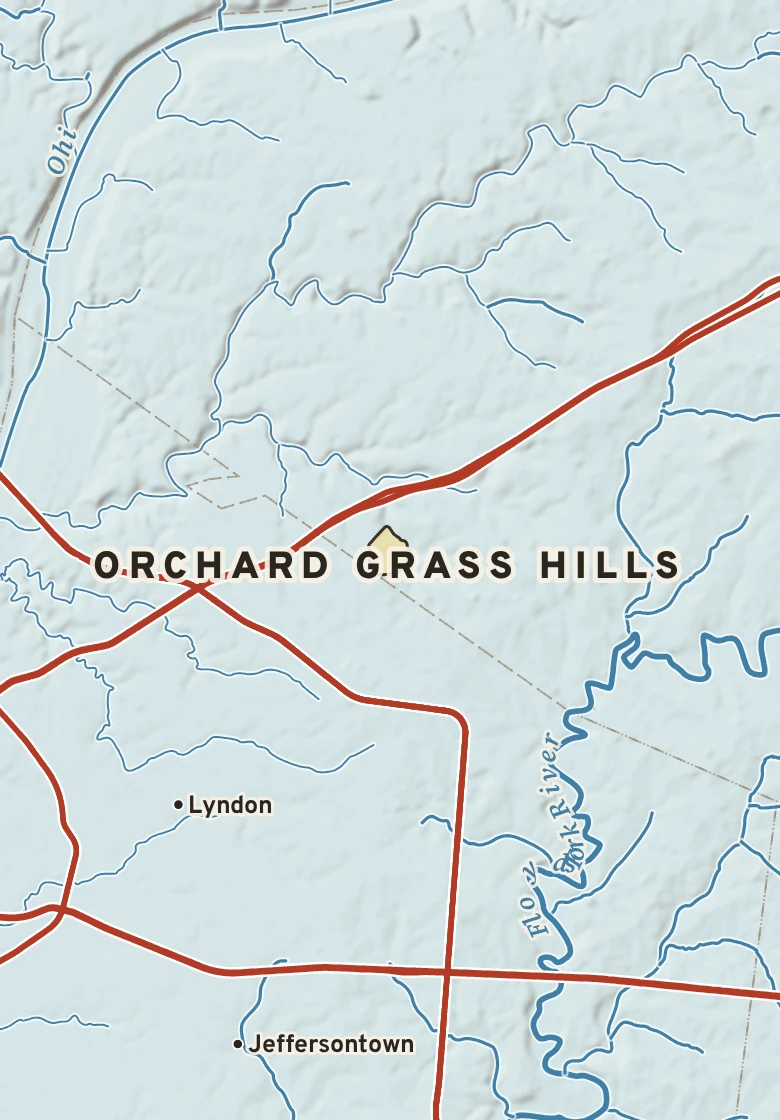
The Orchard Grass Hills plate. Relief from Copernicus GLO-30; rivers and lakes from USGS NHD; watersheds from the USGS Watershed Boundary Dataset; roads and city limits from Census TIGER 2024.
3.14 inches of rain fell in two days, the most for this week of the year since records began in 1945. The next wettest, 3.08 inches, fell in 2024.
Orchard Grass Hills’s center stands about 710 ft above sea level. Within three miles the land runs from 580 ft to 800 ft, a difference of 220 ft: rolling country.
The section below crosses 4 rock units mapped at the surface.
Heights every 0.1 mile from the Copernicus GLO-90 surface model; vertical exaggeration about 44×. The colored band under the surface is the rock the state geologic map shows at the surface, not a picture of what lies beneath.
Dolostone. Age: Ordovician, 445 to 487 million years old. About 9 mi of the line.
Limestone. Age: Early Devonian to Middle Devonian, 384 to 422 million years old. About 7 mi of the line.
Limestone. Age: Silurian, 422 to 445 million years old. About 6 mi of the line.
Dolostone. Age: Silurian, 422 to 445 million years old. About 2 mi of the line.
From the USGS State Geologic Map Compilation (Horton and others, 2017), the states’ geologic maps joined at a common scale.
Heights from Copernicus GLO-90 (a surface model: it includes buildings and tree canopy); summits from USGS GNIS; rivers from USGS NHDPlus HR; rock from the USGS State Geologic Map Compilation.
A raindrop that lands in Orchard Grass Hills reaches the Gulf of America by way of South Fork Harrods Creek, Harrods Creek, the Ohio and the Mississippi: about 1,360 river miles.
970 miles of the trip are on the Mississippi.
Traced down the USGS NHDPlus V2.1 river network from the Census center point of Orchard Grass Hills; river miles along the main stem, rounded.
Orchard Grass Hills has a humid subtropical climate. Summer afternoons average 89° in July; winter nights fall to about 28° in January. A normal year brings about 13 inches of snow; with the rain, that comes to about 48 inches of water.
On November 14 Orchard Grass Hills normally reaches 58° and falls to 40°. The record high is 76°, in 2011; the record low 15°, in 1986. The most rain on this date, 0.89 in, fell in 2024.
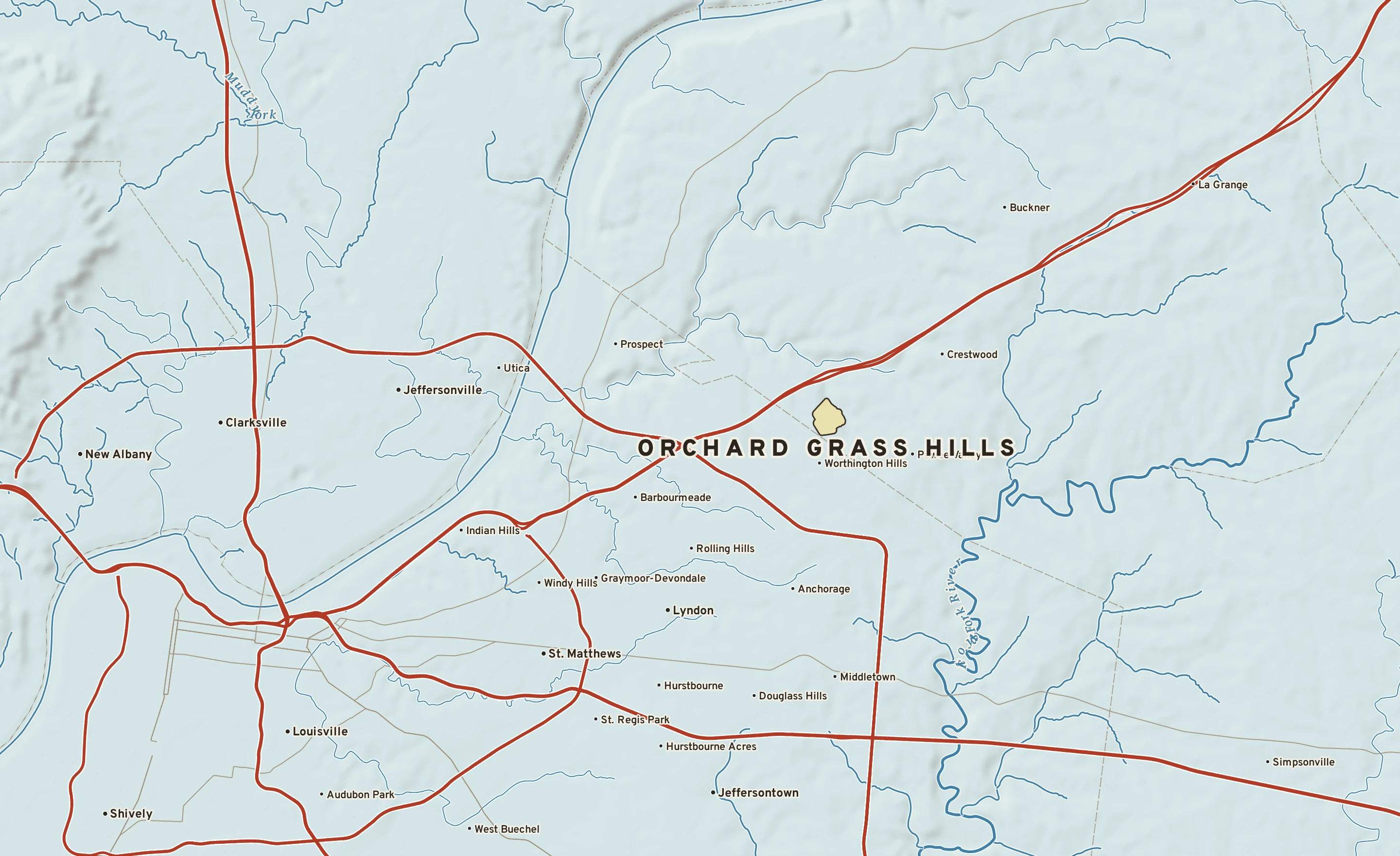
Normals 1991–2020 and records since 1945 at Louisville Bowman Field, 10 miles southwest, 170 ft lower. NOAA, through RCC-ACIS.