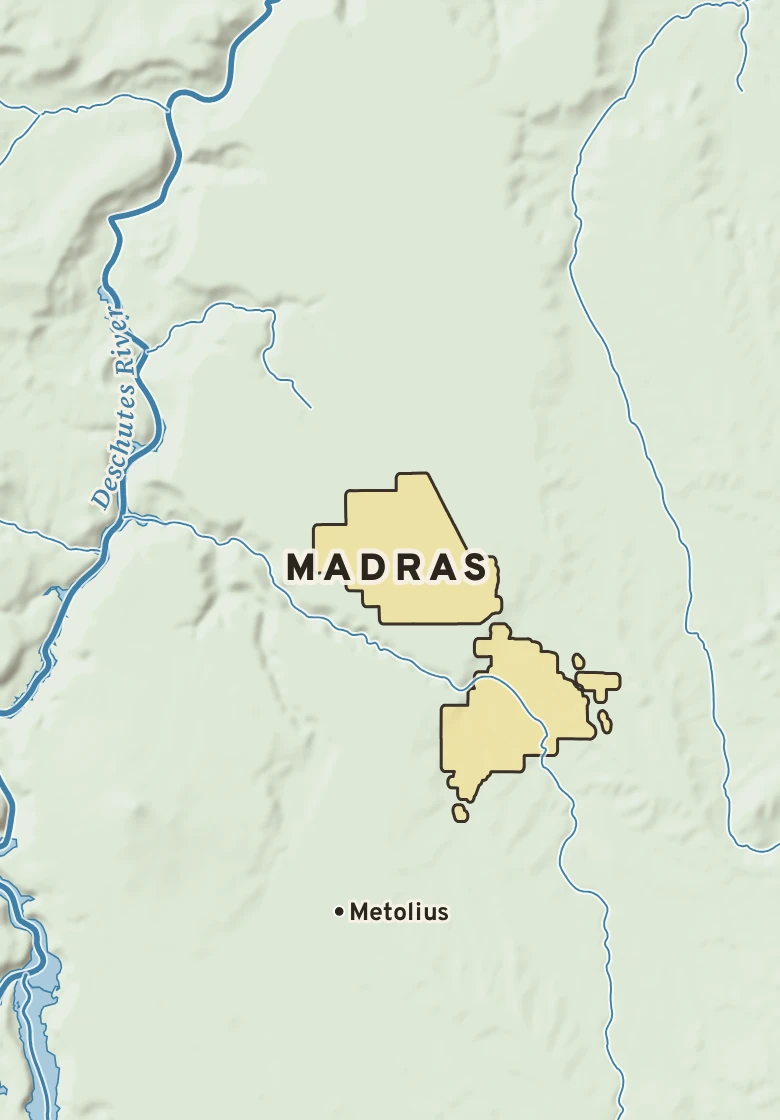
The Madras plate. Relief from Copernicus GLO-30; rivers and lakes from USGS NHD; watersheds from the USGS Watershed Boundary Dataset; roads and city limits from Census TIGER 2024.
77° on Nov. 13, 1999, the hottest reading for this week of the year since 1909. Next is 75° in 1990.
Madras’s center stands about 2,420 ft above sea level. Within three miles the land runs from 1,930 ft to 2,540 ft, a difference of 610 ft: hilly country. The highest named summit within 15 miles is Baldwin Hills, about 4,160 ft, 11 miles east-southeast.
Under the town center the state geologic map shows Olivine basalt, from the Miocene to Pliocene, 2.6 to 23 million years old.
The section below crosses 4 rock units mapped at the surface.
Heights every 0.1 mile from the Copernicus GLO-90 surface model; vertical exaggeration about 8×. The colored band under the surface is the rock the state geologic map shows at the surface, not a picture of what lies beneath.
Sandstone, siltstone, mudstone. Age: Miocene to Pliocene, 2.6 to 23 million years old. About 10 mi of the line.
Basalt. Age: Miocene to Pliocene, 2.6 to 23 million years old. About 8 mi of the line.
Sandstone-mudstone. Age: Late Eocene to Early Miocene, 16 to 38 million years old. About 5 mi of the line.
Coarse-detrital. Age: Pleistocene to Holocene, less than 2.6 million years old. About 0.5 mi of the line.
From the USGS State Geologic Map Compilation (Horton and others, 2017), the states’ geologic maps joined at a common scale.
Heights from Copernicus GLO-90 (a surface model: it includes buildings and tree canopy); summits from USGS GNIS; rivers from USGS NHDPlus HR; rock from the USGS State Geologic Map Compilation.
A raindrop that lands in Madras reaches the Pacific Ocean by way of Campbell Creek, the Deschutes and the Columbia: about 310 river miles.
200 miles of the trip are on the Columbia.
Traced down the USGS NHDPlus V2.1 river network from the Census center point of Madras; river miles along the main stem, rounded.
Madras has a cold semi-arid climate. Summer afternoons average 86° in July; winter nights fall to about 21° in December. About 9 inches of rain fall in a normal year.
On November 14 Madras normally reaches 49° and falls to 26°. The record high is 69°, in 1969; the record low −6°, in 1955. The most rain on this date, 0.61 in, fell in 1966.
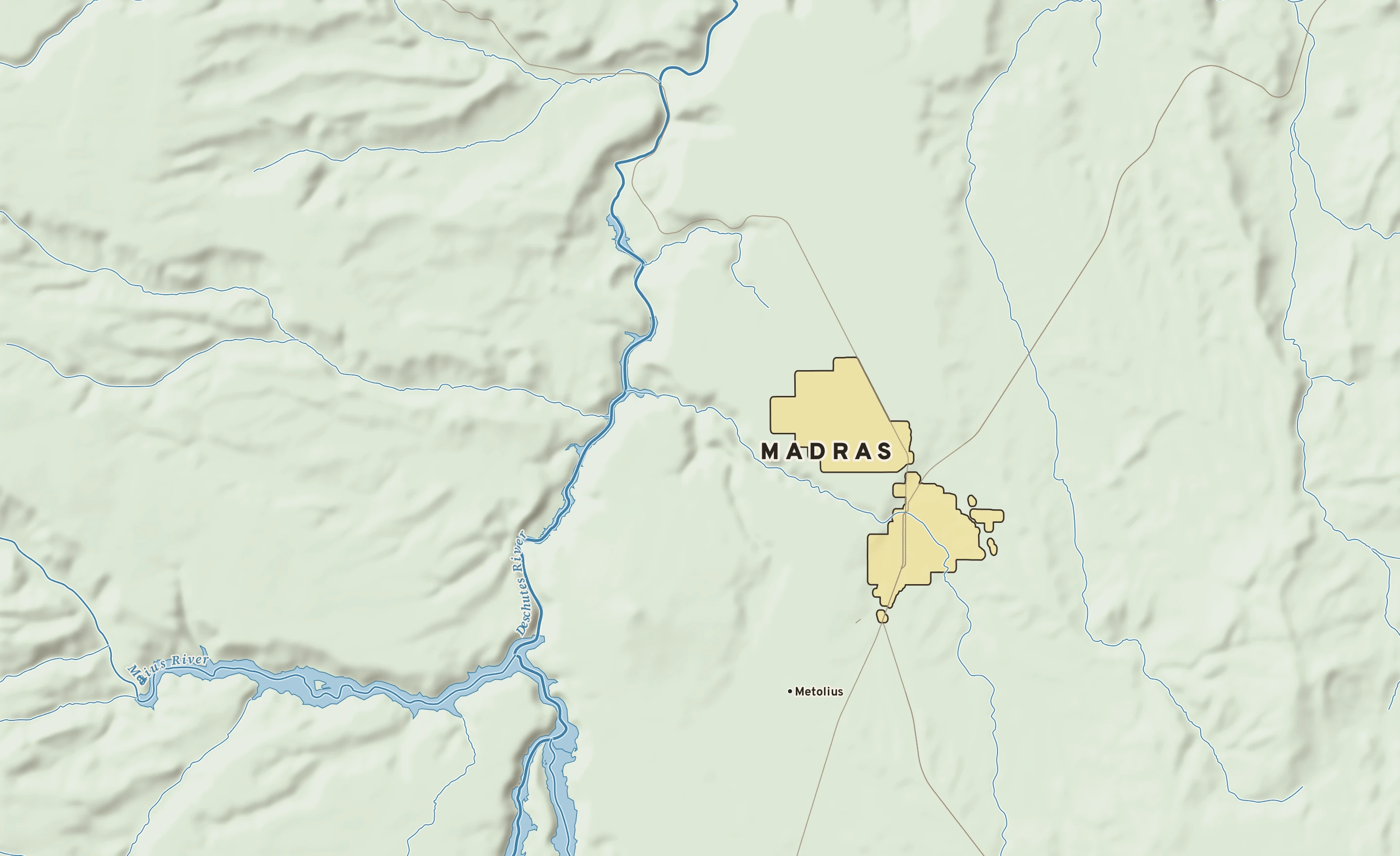
Normals 1991–2020 and records since 1909 at Madras, 4 miles southeast, 140 ft lower. NOAA, through RCC-ACIS.