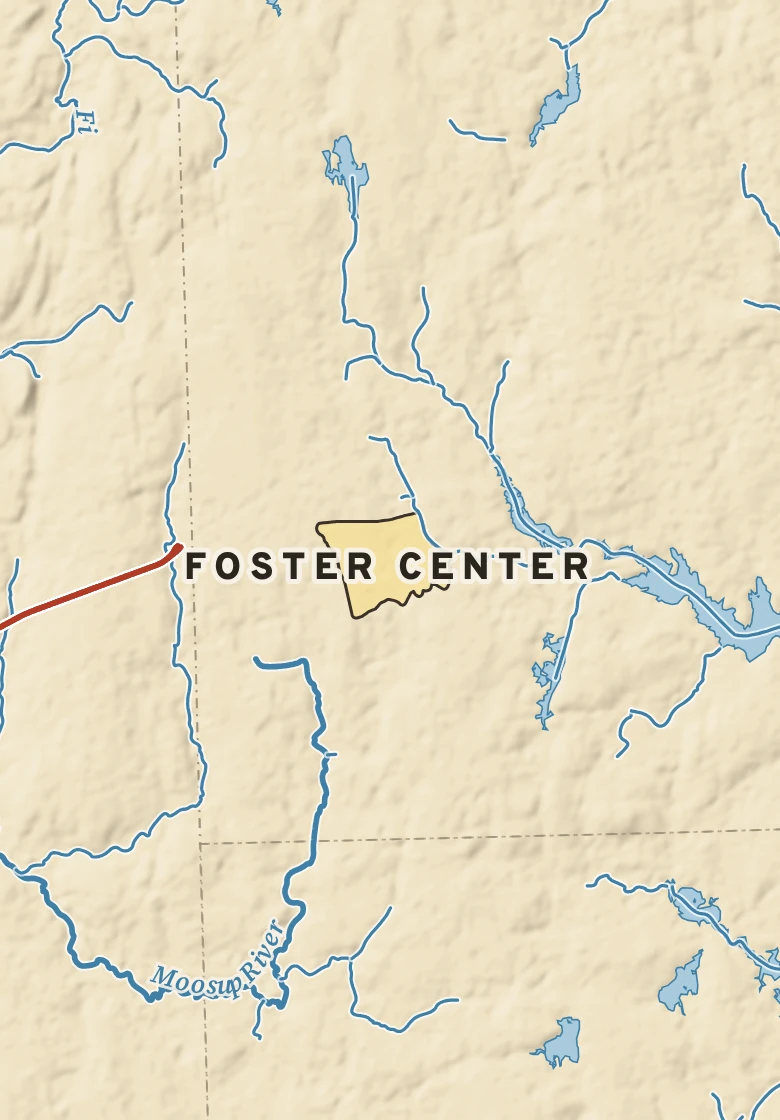
The Foster Center plate. Relief from Copernicus GLO-30; rivers and lakes from USGS NHD; watersheds from the USGS Watershed Boundary Dataset; roads and city limits from Census TIGER 2024.
75° on Nov. 15, 1993, the hottest reading for this week of the year since 1974. Next is 70° in 2020.
Foster Center’s center stands about 570 ft above sea level. Within three miles the land runs from 350 ft to 710 ft, a difference of 360 ft: rolling country. The highest named summit within 15 miles is Jerimoth Hill, about 860 ft, 5 miles northwest.
The section below crosses 15 rock units mapped at the surface.
Heights every 0.1 mile from the Copernicus GLO-90 surface model; vertical exaggeration about 31×. The colored band under the surface is the rock the state geologic map shows at the surface, not a picture of what lies beneath.
Granite. Age: Late Devonian, 366 to 380 million years old. About 6 mi of the line.
Gneiss, amphibolite. Age: Neoproterozoic, 542 to 1,000 million years old. About 4 mi of the line.
Alkali-feldspar-granite. Age: Late Devonian, 366 to 380 million years old. About 3 mi of the line.
Quartzite. Age: Neoproterozoic, 542 to 1,000 million years old. About 1 mi of the line.
Gneiss. Age: Neoproterozoic, 542 to 1,000 million years old. About 1 mi of the line.
From the USGS State Geologic Map Compilation (Horton and others, 2017), the states’ geologic maps joined at a common scale. 9 smaller units along the line are not listed.
Heights from Copernicus GLO-90 (a surface model: it includes buildings and tree canopy); summits from USGS GNIS; rivers from USGS NHDPlus HR; rock from the USGS State Geologic Map Compilation.
A raindrop that lands in Foster Center reaches Narragansett Bay and the Atlantic Ocean by way of Hemlock Brook, the Ponaganset, the Pawtuxet and the Providence: about 35 river miles.
Traced down the USGS NHDPlus V2.1 river network from the Census center point of Foster Center; river miles along the main stem, rounded.
Foster Center has a warm-summer humid continental climate. Summer afternoons average 80° in July; winter nights fall to about 19° in January. A normal year brings about 62 inches of snow; with the rain, that comes to about 54 inches of water.
On November 14 Foster Center normally reaches 50° and falls to 33°. The record high is 72°, in 1993; the record low 11°, in 1986. The most rain on this date, 2.03 in, fell in 2009.
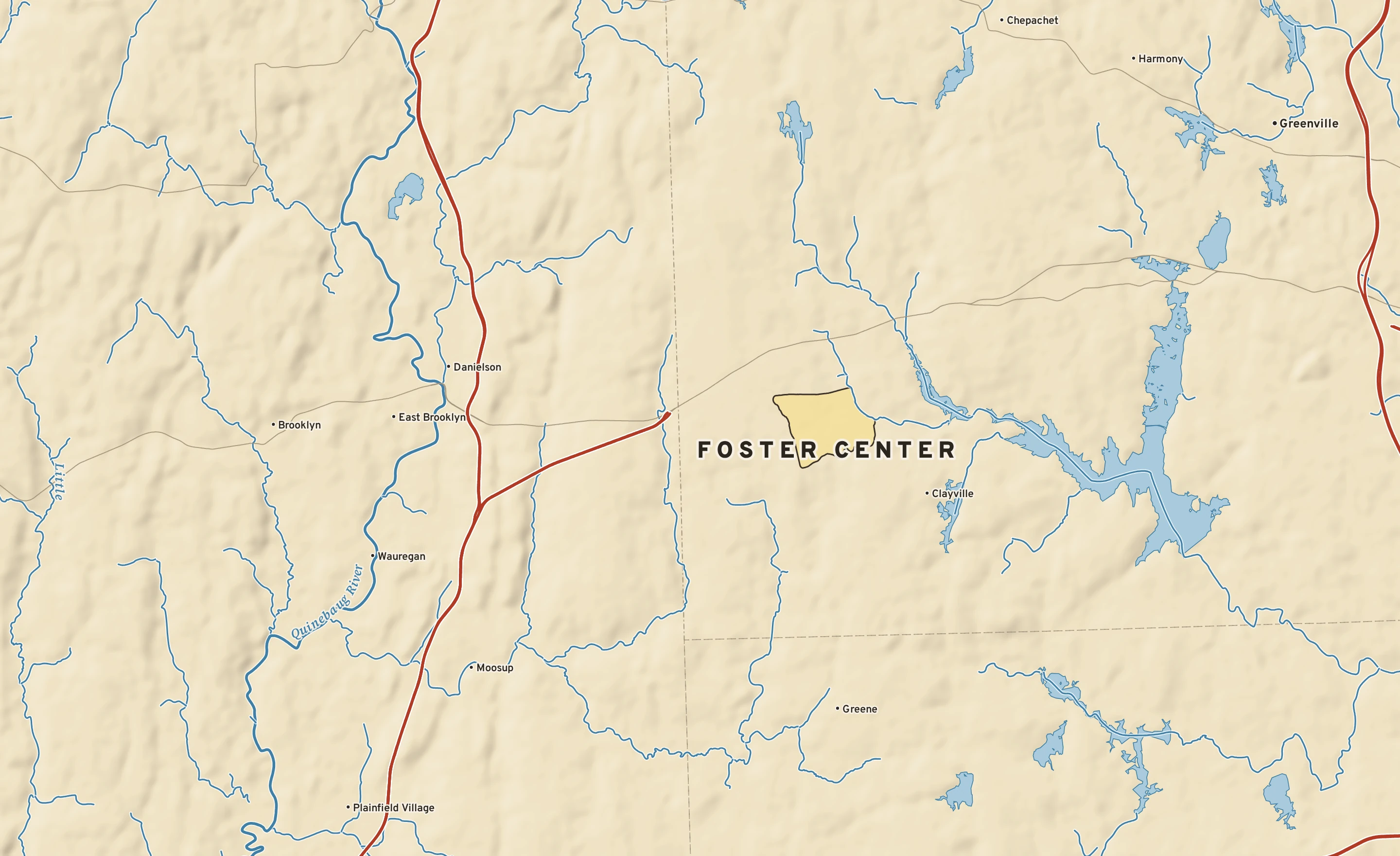
Normals 1991–2020 and records since 1974 at North Foster 1 E, 5 miles north. NOAA, through RCC-ACIS.